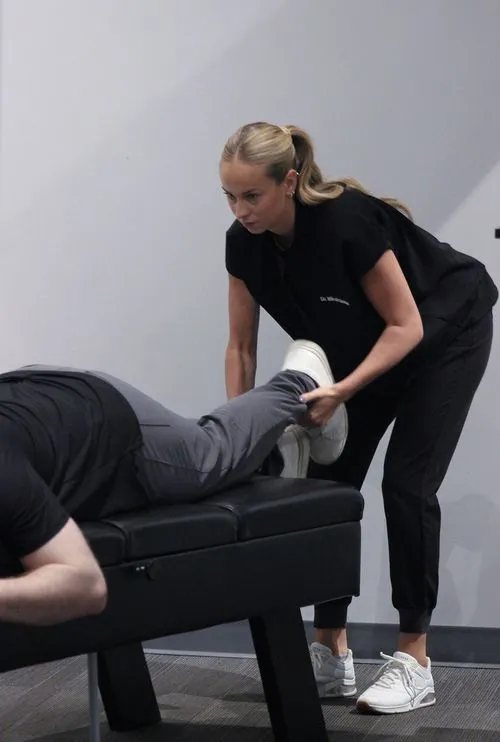
Looking for targeted relief from herniated discs, sciatica, or spinal stenosis? We utilize the advanced DOC table and evidence-based corrective care protocols to bypass muscle guarding, achieve negative intradiscal pressure, and promote genuine healing without surgery.
Research-supported mechanism: Decompression creates negative intradiscal pressure (-100 to -200 mmHg), promoting retraction of herniated disc material and influx of nutrients essential for healing (Ramos & Martin, 1994).
Clinical effectiveness: A systematic review found that 86% of patients with herniated or degenerative discs reported significant pain reduction, maintained at long-term follow-ups (Macario & Pergolizzi, 2006).
Not the same as traction: True decompression uses variable force curves that bypass the body's protective muscle guarding reflex, achieving pressure changes that linear traction cannot replicate.
Ideal candidates: Patients with MRI-confirmed herniated/bulging discs, degenerative disc disease, sciatica, or spinal stenosis who haven't responded to medication or physical therapy.
Treatment timeline: Clinical protocols typically involve 12–24 sessions based on severity, with most patients reporting measurable symptom improvement within the first 4–6 sessions.
Important contraindications: Not appropriate for patients who are pregnant, have severe osteoporosis, have prior spinal surgery with hardware, or have unstable spinal fractures.
Intervertebral discs function as hydraulic shock absorbers. When a disc herniates or bulges, it pushes outward, compressing adjacent nerve roots. Traditional treatments address pain but don't directly affect the disc itself.
Controlled distraction forces create measurable negative pressure within the disc space. This draws herniated disc material back toward the center and creates an osmotic gradient that pulls water, oxygen, and nutrients into the disc for repair.
Standard traction applies a constant pull, triggering the body's muscle guarding reflex. True decompression systems use logarithmic force curves that gradually increase and decrease tension in patterns the body cannot anticipate, bypassing this reflex entirely.
Most tables are limited to linear pulling. Our DOC table offers supine or prone positioning, lateral flexion, and rotational decompression. This multi-planar capability allows us to target the specific angle of your disc herniation.
reported significant pain reduction
(Shealy & Borgmeyer, 1997)
improvements maintained at follow-up
(Macario & Pergolizzi, 2006)
negative intradiscal pressure achieved
(Ramos & Martin, 1994)
In a study of 778 patients with herniated and degenerative discs, 86% reported immediate resolution or significant improvement. Decompression therapy appears particularly effective for patients who have failed other conservative treatments.
Ramos & Martin demonstrated that controlled distraction forces produce measurable negative intradiscal pressure, dropping to -100 to -200 mmHg within the disc space—levels sufficient to promote disc retraction.
Cyclic loading and unloading of intervertebral discs stimulates disc cell metabolism and promotes proteoglycan synthesis. This creates conditions for actual disc tissue repair rather than just temporary symptom relief.
Visit 1 includes a 3D biomechanical examination and full-spine digital X-rays to evaluate alignment, joint mobility, and structural integrity before any treatment begins.
Visit 2 reviews all imaging. If decompression is appropriate, you receive a detailed care plan specifying the number of sessions (typically 12 or 24) and expected milestones.
We precisely program the table's distraction angle, patient positioning, and force parameters based on the specific target disc level and your unique pathology.
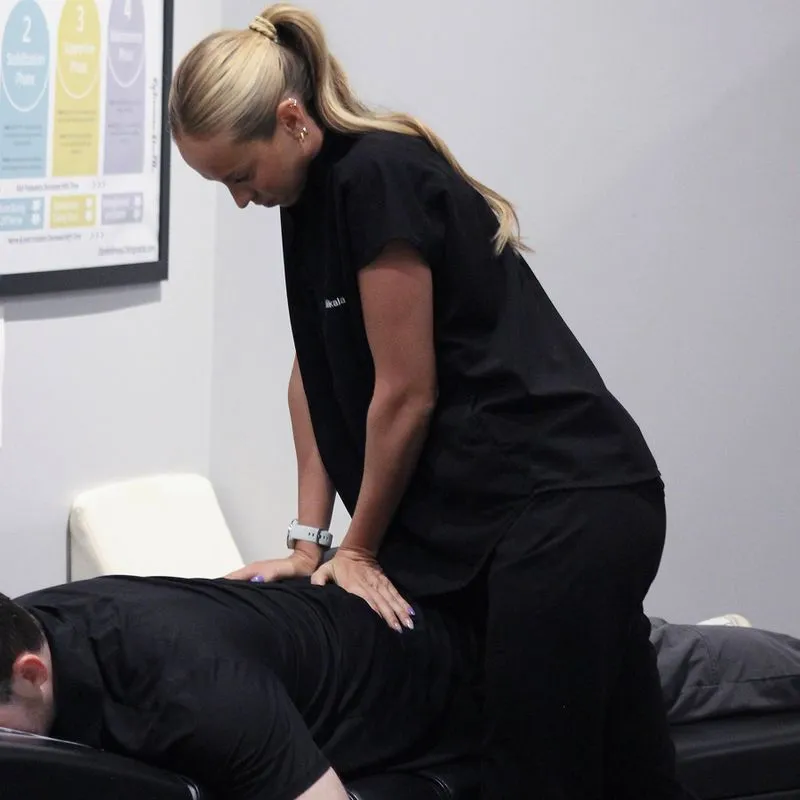
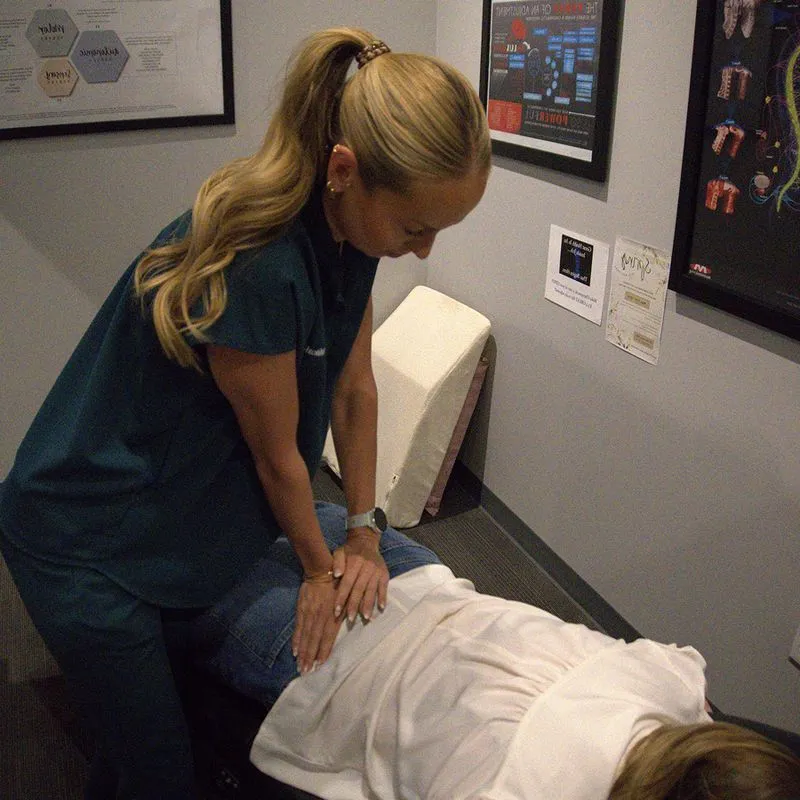
We combine decompression with structural chiropractic adjustments to fix misalignment, Pettibon corrective protocols for posture, and access to our recovery suite.
Most patients begin with 3 sessions per week. Wear loose-fitting clothing and avoid large meals beforehand to ensure maximum comfort on the table.
Secured in the DOC table, you'll feel a gentle, comfortable cyclic stretching (15-25 minutes). Many patients find it so relaxing they fall asleep.
Dr. Booher may perform complementary adjustments. You can utilize our recovery room (infrared sauna/cold plunge) to reduce inflammation.
While decompression demonstrates strong clinical evidence, it is not appropriate for every patient. If you have spinal fusion hardware (rods, screws, cages), are pregnant, have severe osteoporosis, or have unstable spinal fractures, decompression therapy is contraindicated. We evaluate surgical history (like simple discectomies) on a case-by-case basis.
If your pain is primarily from facet joints rather than disc pathology, standard chiropractic adjustments may be more appropriate and cost-effective. We maintain referral relationships with orthopedic spine surgeons and pain management physicians to ensure coordinated care if you have progressive neurological deficits or require combined approaches like epidural injections.
Still have questions? Call us at (512) 328-3800 or book your visit.
"For the last three weeks I've visited Dr. Mikala... I thoroughly enjoy their unique approach to treating the whole body. I work in the dental field, yrs of leaning awkwardly have reeked havoc. With Dr. Mikala's help the discomfort my sciatic nerve produced is almost nonexistent. The office staff is so welcoming!"
"I was told surgery was my only option for my L4-L5 herniation. I could barely walk to my mailbox. Dr. Booher put me on a decompression and adjustment protocol. Three months later, I am fully avoiding the operating room and playing golf again."
"The shooting pain down my leg was unbearable. The Elite Wellness team didn't just 'crack my back'—they mapped exactly which nerve was compressed and systematically took the pressure off. Truly life-changing non-surgical care."
Evidence-based corrective care for lasting lower back pain relief.
Learn MoreRelief for shooting nerve pain radiating down your leg.
Learn MoreSpecialized whiplash treatment and comprehensive recovery protocols.
Learn MoreCorrective care for tech neck, whiplash, and cervical disc issues.
Learn More
If you haven't found lasting relief from medication, injections, or physical therapy alone, spinal decompression therapy may be the missing piece. We combine true spinal decompression with structural corrective care to address the root cause of your disc-related pain.
*Dr. Mikala Booher, DC serves Bee Cave, Lakeway, West Lake Hills, Dripping Springs, and Southwest Austin.
Adams, M. A., & Roughley, P. J. (2006). What is intervertebral disc degeneration, and what causes it? Spine, 31(18), 2151-2161.
Apfel, C. C., Cakmakkaya, O. S., Martin, W., et al. (2010). Restoration of disk height through non-surgical spinal decompression is associated with decreased discogenic low back pain: a retrospective cohort study. BMC Musculoskeletal Disorders, 11, 155.
Arun, R., Freeman, B. J., Scammell, B. E., et al. (2009). 2009 ISSLS Prize Winner: What influence does sustained mechanical load have on diffusion in and degeneration of the intervertebral disc? An in vivo study using serial postcontrast magnetic resonance imaging. Spine, 34(21), 2324-2337.
Gionis, T. A., & Groteke, E. (2003). Spinal decompression. Orthopedic Technology Review, 5(6), 36-39.
Gose, E. E., Naguszewski, W. K., & Naguszewski, R. K. (1998). Vertebral axial decompression therapy for pain associated with herniated or degenerated discs or facet syndrome: an outcome study. Neurological Research, 20(3), 186-190.
Guehring, T., Omlor, G. W., Lorenz, H., et al. (2006). Disc distraction shows evidence of regenerative potential in degenerated intervertebral discs as evaluated by protein expression, magnetic resonance imaging, and messenger ribonucleic acid expression analysis. Spine, 31(15), 1658-1665.
Macario, A., & Pergolizzi, J. V. (2006). Systematic literature review of spinal decompression via motorized traction for chronic discogenic low back pain. Pain Practice, 6(3), 171-178.
Ozturk, B., Gunduz, O. H., Ozoran, K., & Bostanoglu, S. (2006). Effect of continuous lumbar traction on the size of lumbar disc herniation. Rheumatology International, 26(7), 622-626.
Ramos, G., & Martin, W. (1994). Effects of vertebral axial decompression on intradiscal pressure. Journal of Neurosurgery, 81(3), 350-353.
Shealy, C. N., & Borgmeyer, V. (1997). Decompression, reduction, and stabilization of the lumbar spine: a cost-effective treatment for lumbosacral pain. American Journal of Pain Management, 7, 63-65.